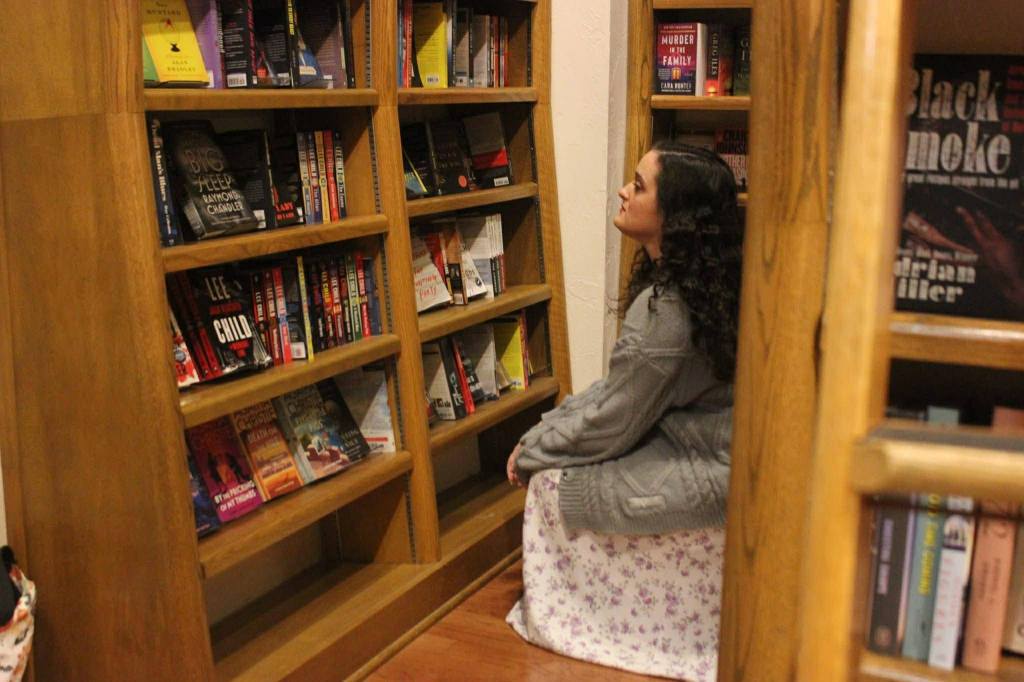
Deconstructing often gets a bad reputation in faith-based communities; oftentimes, people immediately assume it means that someone is leaving the faith altogether, and in some cases, it might, but for some of us, it is just a natural result of religious trauma. Even those who do turn away don’t do it for fun; it’s a hard, slow tearing down of everything you believe. For some of us, we come out with genuine faith, having stripped away all the junk, legalism, and non-mandated traditions. Some do decide they no longer believe at all and “leave,” whether for several years or indefinitely. It’s hard, messy work that brings up a lot of grief and pain. Deconstructing is what happens when someone was never able to really own their faith, when they could not ask questions growing up. Deconstructing is what happens when someone was abused by church leaders or a large portion of the community. When religion was based on shame and rules.
For me, there had always been questions, things I saw, rules that didn’t make sense, or I could not find a verse for, and beliefs or decisions that didn’t add up. I think the first one was when I had to go back to talk to a youth helper that day at VBS, wondering why, if this was such a personal and eternal commitment, people were trying to force it on me. Maybe it was the rules that didn’t have biblical text to validate them, maybe it was the idol worship of sports, politicians, and our country. As a child, I was fearless, inquisitive, and made friends easily. I talked about Jesus and the Church with confidence and genuine love because they were important to me. By the start of highschool all of that had been beaten out of me with shame and condemnation, and I became a shell. I was “the girl they wanted”, pleasing and good. Good girls do not ask questions, good girls plan for their marriage, not college, good girls attend every sunday, good girls sacrifice service to hold babies. Good girls don’t date, they don’t flirt, and they dress modestly. Good girls boycott and vote republican, following the American Family Association’s voter guide to the max. Good girls learn how to keep house and read parenting books. I was deep into Christian conservative traditional womanhood and fully committed.
I thought I was doing right, I thought I was pleasing God, I so desperately wanted to prove I was a good girl, but underneath, there was always this current. I was told that being a “good girl” would keep me safe, and I feared displeasing authority. Somewhere deep down there was still that little girl who believed in women warriors, who had wanted to have a career, who had asked questions and used her voice. She came out in some subtle ways, reading Harry Potter (very conservative in my community), listening to female rage music, and I was also completely addicted to the TV show “Legend of the Seeker.” The women in that show have their own destiny, purposes, and jobs, and I loved it. But I kept that girl down, only letting her out to play on very rare occasions; she could not be trusted to behave herself. By the time I turned eighteen, I had her almost completely silenced. For years, I held the “good girl” identity; it was a survival skill and a mask that made me appear non-threatening.
I didn’t set out to start deconstructing; there was no “one moment” but a thousand small ones over the span of several years. I didn’t do it for grins and giggles; in fact, it was the opposite. I thought I was going mad at multiple points. I started having the thoughts in 2020. I had been “free” for a few years, was finally living with just a roommate, and was fully out in the world. This was just little whispers or occasional conversations that were questioning my reality. At the same time, I was also starting on the endless amount of emotional baggage I carried around with me, and it was hard to think around all that junk. A big pivotal moment was when a close friend, whom I thought was the perfect and ideal Christian woman whom we should all strive to be, got pregnant outside marriage. She was even more committed to the “good Christian conservative woman” than I was. I was baffled and didn’t know how to process that. After all, weren’t all those rules and traditions supposed to prevent that? A crack formed in my wall of beliefs.
Quietly, I started listening and learning, but the real work started in the summer of 2024. One Saturday morning, I had dug out my swimsuit, tank top, and taken the dog for a walk like normal. I stared in the mirror and wished I didn’t have to wear so much clothing. I remember complaining to God that it wasn’t fair that my friends could wear sports bras and shorts to run, or they could wear two pieces to swim. While on the walk, I asked Him why He called me to follow all these extra rules. Then, clear as day, I heard His voice say, “When did I ask you to do that?” I came to a dead stop in the middle of the road. When did God ask me to do that? He asked me to dress with dignity and asked all Christians not to willfully cause their fellow brother or sister to stumble, but when did God and I discuss what that meant for me? The truth was, we hadn’t ever. I read in one of the numerous purity culture books that showing my midriff would tempt every man within eyesight of me, the cute boy, the kid I was babysitting, my friend’s dad, and grandpa, even possibly my own father. So I set the rule; I had never questioned if I felt conviction from the Holy Spirit. I had been going off of what Purity Culture books had taught me growing up. So I asked the Holy Spirit, “Is it a sin for me to wear a two-piece?” and again I heard his answer, clear as day, “No,” so for the first time at age 29, I wore a two-piece to the pool to sunbathe and read. (There is more to this story that is not relevant here, but it’s funny, so ask me about it sometime). From that day on, I asked what was okay and what was not, and so the deconstruction process began.
Thanksgiving of 2024, I pulled out a book written by Josh Harris’s ex-wife. He was a big leader in the “Purity Culture” movement and the “Courtship” tradition. I had slowly begun deconstructing my modesty rules, which led to asking questions about my beliefs on dating. I was curious what had happened, how this perfect and ideal role model couple’s marriage had ended in divorce, so I got the audiobook from the library and decided to listen while I started deep cleaning my apartment for Christmas. It was enlightening and jarring. Everything Josh said in his books was a lie; there was so much that went on behind the scenes. More to the story, she was shamed, silenced, and abused. The next deconstruction book I read was “A Well-Trained Wife” by Tia Leveings. Both Harris and Levings told stories of my past; they grew up in similar religious communities, and a lot of their goals and “dreams” were the same as mine, and the road I had been headed down. I had an anxiety attack while listening to them. For the first time, I saw the path I had been on, and through the memoir of these two women, I got a glimpse of where that path ended. For the first time, I then praised God for keeping me single in my 20’s for not answering that prayer, because there is a very good chance I would have ended up in a very unsafe environment. At the same time, I started reading the series “A Court of Thorns and Roses” (aka ACOTAR), and strangely enough (or planned by God), all the books I read that long weekend tied together nicely; all were about a woman who was boxed in and told who she had to be and what rules she had to follow. Listening to two real women process their trauma and history, and also reading about it in a fictional setting, somehow opened up the pathways in my mind. The combination broke me, and the floodgates opened. All the questions I had left buried for over a decade came spilling out faster than I could even put them into words.
Over the next 6 months, I read dozens and dozens of books, listened to podcasts and watched documentaries, and asked questions. The wall came tumbling down, and everything was in ruins. I didn’t know what was true and what wasn’t, who to trust and who not to. This was the part where I started questioning my own sanity, spent sessions crying in my therapist’s office, and there was no refuge because even my dreams were haunted by questions. I would sit in service, and my brain would dissect every lyric in every praise song; my notes were filled with questions or things to look up. My only escape during this time was reading fiction; ACOTAR had led me to a whole list of strong female lead characters overcoming trauma and fulfilling their destinies. These strong fictional women became my sisters in arms, reminding me very much of the types of characters that young Shelby loved, before I forced myself into that “good girl” mold.
As the time passed, I grew more and more angry, angry at what I had been taught, angry at how small I had made myself. I truly started to process the pain and betrayal of my former church community. Realizing they cared more about the youth pastor turned sex predator than the domestic abuse victims. All the anger towards those teachers and leaders that shamed me over tithing and bringing friends to church came up. Wave after wave of long-repressed feelings just kept coming. I didn’t realize exactly how deep this would go, how much unprocessed pain there was, how much deep-rooted bitterness. I knew something was blocking me from truly opening up to my new church, but I had not figured out what it was until this point. I even dealt with some anger towards my mother for sheltering me so much, for not letting me see the outside world. Logically, I know that she was also abused, and we were both trapped, but I had never dealt with the impact of what being raised so sheltered and protected from the world had on me. How much I had to catch up on once I was out here and how much I did not know about other communities, relgious and political standpoints. I didn’t know how much some communities suffered, about homelessness or about sex trafficking in my own city. I was so overwhelmed by the pain around me and exhausted from trying to sort everything out.
April 20th, 2025, it was Easter sunday and for the first time in my life, I chose not to go to church. Good Friday had been hard. I had been in kids’ ministry, and for the first time, I remember thinking, “We are teaching this to kids, but do I even believe this?” I broke out in a cold sweat in the middle of serving; I had to press it down. I could not deal with this now, but the unspoken question I knew I had to ask lingered. Finally, on that Easter morning, I was sitting on a rock by the creek in my neighborhood, and I could no longer take it. I had to ask, I had to know, I had hit the bottom of the pit, so shaking and terrified, I asked the question that had been haunting me.
“God, are you real?”
I think this is when I started crying, not quiet pretty tears but the guttural sobbing that happens when things are this deep. Immediately after asking, I knew the answer, not because I was reading a book that informed me of the fact, not because some preacher was telling me what to believe, not even because my parents were telling me. I knew because I felt Him, in a way I had not in so long, it was like the sensation of being scooped up in an adult’s arms after you skinned your knee. I knew He was real, deep in my bones, in the bottom of my heart, every broken piece of me. I let out a shaky breath, then did something I should have done in November: I invited God into my deconstruction process, and that is when everything changed. I wouldn’t say things were easy from that point on, but I had more clarity and peace throughout.
Realizing you don’t know the why behind any of your beliefs, traditions, or political views was terrifying and jarring. I had always prided myself on being such a bookworm and self-educated, but the truth is, I wasn’t, because I had still been reading only what supported my belief system, what confirmed my beliefs. I grew up in an environment where adults and authority did not appreciate questions. It was not common to read what the other side of political views believed, which might “lead us astray”. I don’t remember debating or learning from others’ perspectives; it was “we are right, they are wrong, and Jesus is on our side”. Politically, I remember that if you were on Jesus side, you voted for this party, and if you were against Him, then you voted for that party. This made me terrified to let my questions and thoughts surface. I didn’t want to be seen as “falling away” or “against Jesus”. When I graduated from highschool I watched some of my friends deconstruct their first year of college. I remember hearing that some had “fallen away” or “turned their backs”; the adults would talk about someone as if they had died. Sometimes they had completely left God and the Church, some had just changed denominations, or voted differently than their parents did. Looking back, I see that for what it was, manipulation to keep us in line. If your beliefs are the truth, then being debated and questioned is welcomed. I knew I still loved Jesus, I knew God existed, and I could feel the Holy Spirit, but everything else was hazy and confusing.
As 2025 went on, I continued deconstructing, continued learning and educating myself, and with God now involved, I didn’t feel like I was going mad. Just a few short weeks after I ended up on the mission trip to Mexico, I knew I believed in God, but everything else was still unknown. I was shocked that the opportunity rose (I will post the testimony from that trip later), and when I agreed, I asked God to show me, show me if church mattered, if evangelism (when used lovingly and respectfully) worked. I told Him I would go with an open heart and mind. I also asked Him to show me that I could trust my church. On that trip, I got to ask one of the pastors questions, and guess what, there was no judgment, no dismissal, and no anger. I also ended up getting sick on the trip, and this time, when I was at my weakest and I needed help, my church was there to catch me. When I came back, I had so many answers to my questions, and the church became a refuge again, and I was fully re-committed to serving. I no longer felt so lonely and could now bring up bits and pieces of my journey to the community. I was all in.
The mission trip was a turning point for my journey. Over the second half of the year, I continued deconstructing, but my mindset felt calmer. I was able to move from anger to forgiveness. There was some grief that came with this part of the journey, grief for that little girl who was shamed for who she was, for that teen who became so legalistic she could not breathe, and for that young woman who felt abandoned by her church community. Around this time, I also began to see the flaws in all the “Christian living” books I read, and how they twisted scripture, and some were even straight-up misogynistic. No longer did I believe my only option was to stay home and raise kids, no longer did I believe I was only the help meet in some mythical future husband’s story. This was the realization that God does not require those things and that being a stay at home mom was not “more holy’ than becoming a doctor, or therapist, or lawyer. The hard part about that realization was that I had trained to be a good wife, not a good Christian. I wasted so many years trying to figure out how to be the most pleasing and demure woman I could be, and it was hard to swallow the fact that it was all a lie and that men were different that what I had been taught.
As 2025 came to a close, so did deconstruction; the journey wasn’t over, but it had reached a place of stability with the process. A friend commented later in the year that I was so much different and more open; it wasn’t just that I was more emotionally and mentally healthy, but it was also this journey. In December of 2025 and January of 2026, I completed the goal of re-reading all the Christian books I owned, learning how I got to where I was in my teens and early twenties. As I turned 31, I let this chapter close. I am still reading and learning, but now, as what I call “reconstruction”, the rebuilding of my beliefs. As things come up, I look at and investigate them, comparing with scripture, with context, and looking at several perspectives and points of view. I am still reading a few books, but they are not my sole project now. Deconstruction does not always mean you are leaving your faith completely; sometimes it just means that you are asking questions and cultivating a more genuine faith. This process has actually brought me closer to Him. I could write another 2,000 words on this. There has been so much to this journey that I don’t know if I could even describe it all. I have been writing this piece on and off for a long while, and I had to come to terms with the fact that not everyone will understand, some may indeed say “I have fallen away’ or be displeased with me. I had to get to a place where I was okay with that. Others may be angry that it took me so long to do this, which it did; most of my friends got to start this process between 18 and 20, or grew up being able to question, debate, and learn in a safe environment. However, in my early 20’s, I was still in captivity, and all my energy went to surviving. I do not use that as an excuse, but I had other priorities at that time. I also had to come to terms with the regret I feel for enforcing the beliefs I did, for judging others for not holding to the “rules”, and for blindly voting without doing my own research. Anger is another thing that has come up, anger at all the books and teachers that taught me or reinforced this idea, but also anger at myself for letting it happen. For a long while, I hid this journey from everyone, but now I have a strong community where I can ask questions and hear different perspectives. For so long, I would just quietly listen to those with different experiences and perspectives and ponder what they said, but I was afraid to ask or gain understanding; I was still so caught up in what people would think of me. As I have brought up previously, deconstruction was also a huge piece of my healing from religious trauma. Along the way, I found so many roots of shame, fear, condemnation, and enslavement to rules. The freedom and genuine faith this journey has brought me are astonishing. As I did when I was a child, I am able to talk about Jesus, pray, and invite others to church again. I can’t go back and fix the past; all I can do is apologize to both younger me and others, forgive those who contributed to shame and legalism, and move forward as I enter the next part of this journey and reconstruct and rebuild my beliefs.

Leave a Reply